
Start an Escondido Residents Directory Search
No single current book covers Escondido residents. A name search may land on a recorded deed, a court party record, a professional license, a business filing, or a historical directory entry. An address search starts with the parcel. From there you chase documents tied to that land. The right source depends on the question you bring. A deed names the parties to one instrument, while an assessment record describes the land and its value. A directory entry lists a subscriber or household clue for a single edition, and none of these alone proves who lives at an address now.
Keep those distinctions visible from the start. Write down the exact spelling, middle initial, former surname, trust or business name, date range, and street form you used. Escondido records also sit at three levels: city, San Diego County, and California. That layering explains many dead ends. A missing city result may simply belong with the county recorder or a state program instead.
- Start with the Escondido Parcel Lookup or secured assessment search when an address or street is known. Save the APN, situs, parcel status, and legal-description clues.
- Use California My Voter Status only for an authenticated self-lookup. A fuller voter-file request requires a permitted purpose and identity certification.
- Search the San Diego County Official Records Index by grantor and grantee name for deeds, trust deeds, releases, liens, and notices.
- For an older household, request the right year from the Pioneer Room’s city and telephone directory collection, then compare adjacent years and newspaper evidence.
- If a specific identifiable city record is not online, use the City of Escondido request route or the custodian’s counter and phone channel instead of asking an office to research an undefined person.
Where Escondido Resident Records Live
Escondido is incorporated but keeps no county records of its own. The city clerk handles municipal records and routes city requests. San Diego County ARCC combines assessor, recorder, and county-clerk work under one roof. The Superior Court holds case files. State agencies control voter status, vital-record applications, licenses, custody tools, and Safe at Home protections, so the office matters as much as the search term.
San Diego County ARCC
Recorder, Assessor, County Clerk
619-237-0502
Official records, assessment, and certificate services
Escondido City Clerk
201 N. Broadway, City Hall
Escondido, CA 92025
760-839-4617
San Diego Registrar of Voters
5600 Overland Ave.
San Diego, CA 92123
858-565-5800
San Diego County ARCC puts a public web index online reaching back to 1970. It shows index data only, not the instrument image. Ownership is deliberately suppressed from the online secured-roll results. For agendas, rosters, permits, and municipal correspondence, the city clerk's public-record route serves better. County and state channels each answer different questions. So any result you save should note its custodian and date.
San Diego County ARCC's service page covers the combined assessor, recorder, and clerk functions. These are the functions described here.
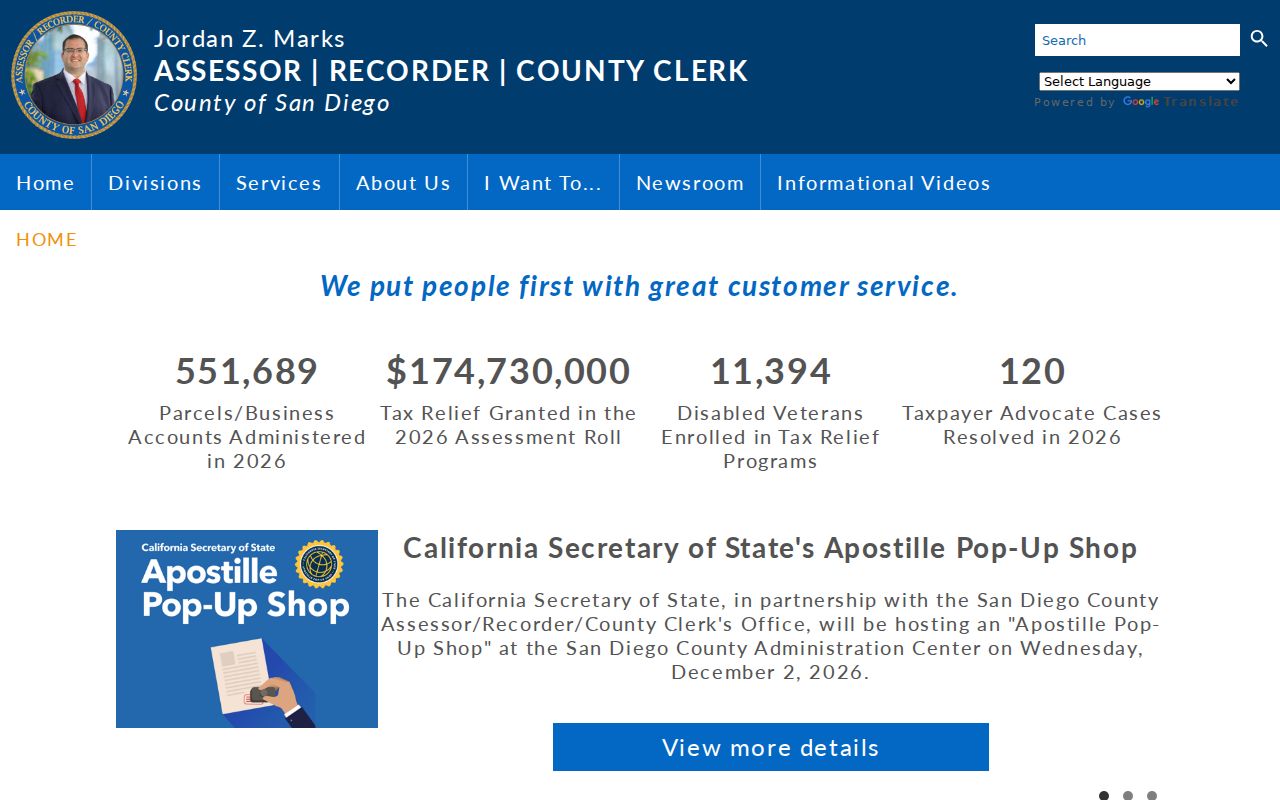
The county office serves as shared custodian for the deed, assessment, and certificate paths. Each path still follows its own access rule.
Escondido Assessor Records by Address
The 2026 Secured Assessment Roll Search takes three routes: Parcel Number, Address, and Street Name. Street Name exists for parcels without street numbers. It also suits a broad pass along one street. A hit can display the APN, situs, land value, and improvement value. It can also show the total assessed value and exemption amount. Owner identity stays off the online result under California Government Code §7928.205, formerly §6254.21.
| Search field | How it helps | What to retain |
|---|---|---|
| Parcel Number | Targets one assessor parcel | APN, status, values, exemption |
| Address | Connects a situs to a parcel | Street form and returned APN |
| Street Name | Finds parcels without a street number | Street spelling and result set |
| Search / Reset | Runs or clears the form | Date of the search |
Start with the free online parcel pass through the secured assessment search. Need lawful ownership information? The ARCC Property Information phone or kiosk channel is the proper route. Escondido parcels sit in the county rolls, so the assessor's record governs. A mailing address is a weaker clue. Even one obtained lawfully may point to a trust or a manager. It may point to an owner who never lived at the property. It proves nothing about who occupies the situs address.
Some municipal records are not searchable online. For those, Escondido's public-record request portal serves as the city-level fallback for directory and records requests.
City files add useful municipal context. Still, the county assessment result remains the authority on Escondido parcel facts.
Modern Escondido Residents Directory Sources
Think of modern directory work as a set of narrow sources. Each has a keeper, a defined access mode, and a limit on what its entries actually mean for an Escondido residents directory. The table below separates ownership clues from residence, history, and official work-contact information so nothing gets mistaken for a city directory entry it is not.
| Source | What it lists | Keeper | Access |
|---|---|---|---|
| Secured assessment roll | Parcels, situs, assessed values | San Diego County Assessor | Free online; owner withheld |
| Official Records Index | Deed and lien parties | San Diego County Recorder | Free index; image by kiosk or copy |
| My Voter Status | Authenticated status and district | California Secretary of State | Personal lookup |
| City staff directory | Public work roles and contacts | City of Escondido | Official city website |
| Licenses and business filings | Professional or entity affiliation | California agencies | Free agency searches |
For one person, the Escondido resident lookup workflow compares two independent clues. Neither is trusted before that comparison. A street works differently. There, parcel geometry and recorded instruments form the useful spine of the search. For past residents of Escondido, the Pioneer Room beats a current roll. Its directories and clippings preserve dated listings a modern residents directory simply drops.
Escondido Voter Lookup Is Personal
My Voter Status is an authenticated self-service check. Prompts may ask for a first name, last name, date of birth, and California driver license or identification details. Other verification may follow. The result can show registration status, party preference, registration address or mailing status, precinct, and district. It also lists election details for the authenticated voter. Keep perspective. A failed match is not proof that anyone is unregistered.
California Elections Code §§2180-2194 governs fuller voter-file access. Section 2194 limits use to election, governmental, scholarly, journalistic, or political purposes. It bars commercial use. An application calls for requester identity, contact details, the geography or data sought, and a permissible purpose. It also requires security commitments and a signed certification. Driver-license data, Social Security fragments, and signatures never appear as ordinary directory fields. Safe at Home addresses are excluded too. Voting history records participation only, never a ballot choice.
That design suits personal verification. It does not suit browsing a whole Escondido street. Historical poll books and registration registers call for a separate archives or library inquiry.
California My Voter Status shows the personal authentication path and its narrow purpose.
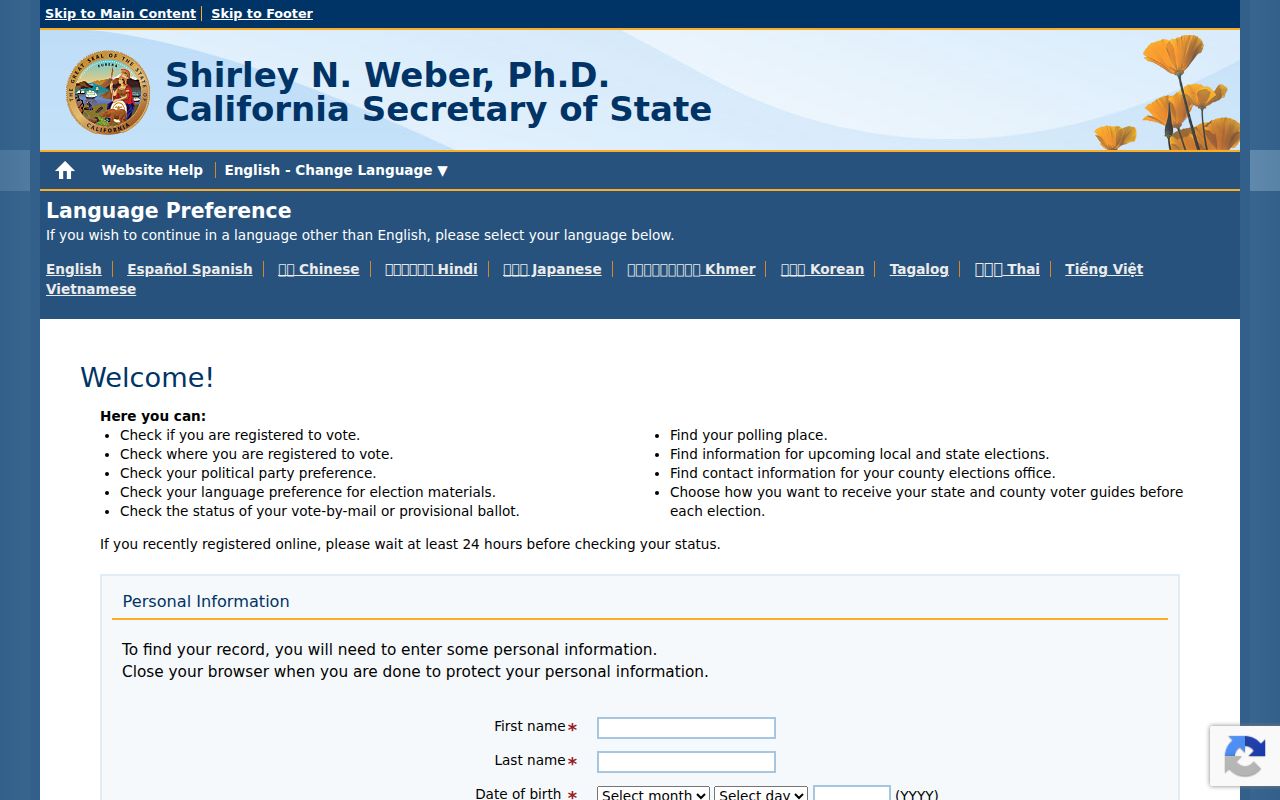
Escondido's form shows your own registration, not a directory.
Escondido's 1970 Recorder Divide
Deeds recorded from 1970 forward sit in San Diego County's online Official Records Index. A free search returns real substance. Party names and grantor or grantee role appear. Document type, recording date, document number, and index references do too. The deed image itself stays behind the counter. Copies come through ARCC by order. Or you can view an image at a public kiosk. A mail request needs the document number, the recording year, a party name, and the document type. Copy fees run $2 for the first page and $0.05 for each added page. Certification adds $1, and a card charge adds $2.50.
AB 1785 reshaped the workflow on December 9, 2024. APN searching vanished from the online index. It survives on kiosks at the five ARCC offices. So for an Escondido parcel, the practical path is address to APN. Then comes an allowed assessor channel or a kiosk session. Records from before 1970 live elsewhere. The County Archives and ARCC's bound books carry the chain through older grantor-grantee indexes. Record series fill in the rest of the history.
ARCC also runs a free Owner Alert service. A single email can watch ten names and ten APNs for anything recorded after enrollment. An alert delivers a document number and a link, not the instrument itself. Treat it as a fraud-notification aid rather than a resident lookup.
Escondido Court Records Are Leads
Escondido matters land at the San Diego Superior Court's North County Division in Vista. The court splits its access routes by case type. Those types are civil, criminal, family, mental health, and probate. A case-number search is the sharpest tool. A party-name search works too, but keep spelling variants in play. Then confirm the courthouse, the case type, and one more non-sensitive fact.
The court's access page lays out three routes. You can go online, to the clerk's window, or use courthouse terminals. A public result can include the case number, title, party names and roles, filing date, category, courthouse, status, register-of-actions events, hearings, and a public disposition. Plenty stays hidden. Sealed records, juvenile cases, adoption matters, confidential family material, and protected identifiers may be absent. Some may be redacted. A docket hit proves named-party involvement. It does not prove a current address or identity by itself.
The county court access screen shows the separate case-type routes before any name search begins.
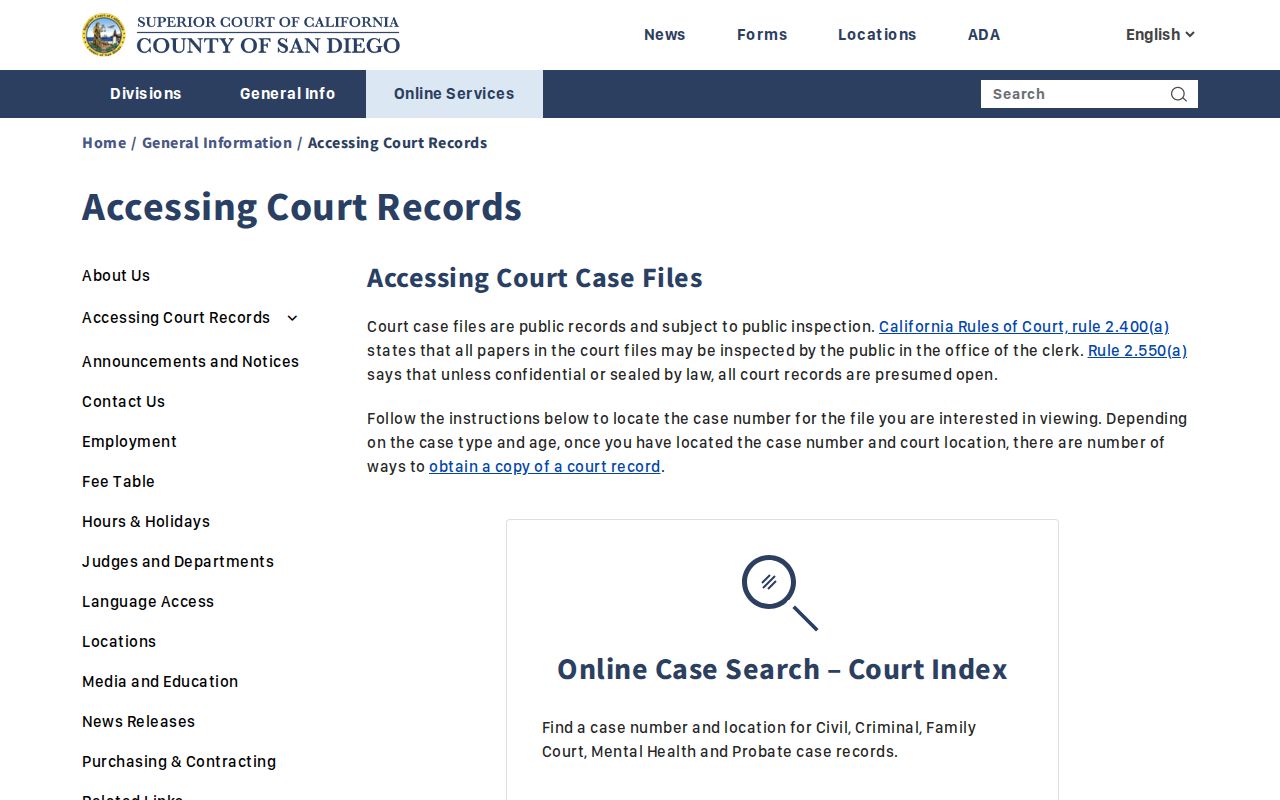
Court access is a lead-finding step. Identity still needs a second independent fact.
Escondido Vital Record Copies
California draws no single age line across its birth, death, and marriage records. Health and Safety Code §103526 splits copies into two kinds. An authorized certified copy can establish identity, but only for listed eligible people. An informational certified copy is stamped as not valid for that purpose. Confidential-marriage copies travel a separate route under Family Code §§509-511, limited to a party or a specified legal process.
San Diego County ARCC and the California Department of Public Health both take applications, for local and statewide vital records alike. The application asks for the event type, names, date and place, parents or spouses where relevant, copy type, eligibility category, signature, payment, and return method. One caution applies to mail. An authorized copy by mail may require a notarized sworn statement. Divorce decrees belong to Superior Court, and CDPH's certificate of record is only a limited abstract for covered years, never the decree itself.
Check the current ARCC birth, death, and marriage instructions or the CDPH Vital Records application before paying. Fees and processing times shift. California also publishes no single live name index covering every vital event statewide.
Escondido's Historical Directory Shelf
Escondido's Pioneer Room keeps city and telephone directories from 1886 through 2018, a run older than incorporation itself in 1888. Business-directory photocopies cover 1913 to 1938. Sanborn fire-insurance maps span 1892 to 1927. Around them sit newspapers, yearbooks, property clippings, city parcel maps, photographs, organizational papers, and research files. An old directory entry can yield a name, spouse, occupation, address, telephone, and sometimes a home mark. Still, it never names every adult at an address.
Volumes from the 1950s through the 1980s also circulate through California Revealed. The 1955 Fifth Edition, from Glendale Directory Co., marks the Escondido prefix with a triangle before the telephone number. Entries list the person, often a spouse in parentheses, an occupation or business, an address, and `h` for home or `r` for residence. Keep the abbreviation key and printed symbols at hand before normalizing any transcription. The full collections and how to read them sit on the Escondido city directory page.
Escondido Directory Shelf at Pioneer Room
The Pioneer Room sits at 247 S. Kalmia Street. Its hours are limited: Thursday 4-8, plus Friday and Saturday 10-2. Nothing circulates, so plan to work on site. Appointments are not required. Even so, advance contact helps with some requests. These include clipping files, fragile material, or oversized plans. Staff welcome local-history, genealogy, obituary, and house-history research requests. That makes the room a quiet complement to any Escondido residents directory search.
The genealogy page confirms in-room access to Ancestry, Fold3, and Newspapers.com. DigitalReel runs on library computers or library Wi-Fi. It is especially useful for local papers before 1995. FamilySearch Affiliate status opens some restricted images. For a remote search, ask with a name or address. Include exact directory years, newspaper dates, and spelling variants. Then treat any staff result as a lead to check against the underlying record.
These shelves hold the human layer that county indexes miss. That includes organizational newsletters, oral histories, personal papers, photographs, and historic-property clippings. The Escondido History Center is a separate institution with its own research center and collections. It reports more than 7,000 photographs and thousands of documents and artifacts. That depth adds context, though it is not an official residence list.
Escondido's Focused CPRA Route
California's Public Records Act is codified at Government Code §§7920.000-7931.000. It lets any person request identifiable, nonexempt state or local records. The agency generally has ten calendar days to determine whether the request seeks disclosable records. A written extension of up to fourteen days is allowed in unusual circumstances. Remember, that deadline is only a determination date. Production may take longer.
For city material, use Escondido NextRequest. Describe an existing record, date range, department, street address or APN, and permit or case number. Also give your preferred electronic format. Search completed requests first. Fire-code and incident records can follow the portal. EMS patient-care information uses a patient or authorized-party channel, because HIPAA restrictions apply. The city need not create a new record. It also need not answer a broad research question. A narrow CPRA request works better than a wide net aimed at an Escondido residents directory.
For a county or state record, send the request to the agency that holds it. Ask for reasonably segregable nonexempt portions and the reason for any redaction. Inspection is ordinarily free. Copies or electronic extraction can carry lawful direct costs. A precise request protects time and leaves a clear trail for correction.
Protected Escondido Resident Addresses
California's Safe at Home program covers qualifying survivors and specified reproductive-health workers or patients. It gives them a substitute mailing address with confidential forwarding. The actual location stays protected. Government Code §7928.205 also restricts posting specified officials' home addresses, and it supports ARCC's online ownership suppression. DMV address data is limited by the federal Driver's Privacy Protection Act. Utility and delivery customer records are not public directory fields. An Escondido residents directory will not surface them.
Lawful personal use. Escondido public records are for family history, civic research, reconnecting, and other lawful purposes. Do not use a name, address, or record trail to stalk, harass, intimidate, or harm another person. Verify a questionable entry with the custodian rather than trying to defeat a confidentiality program.
California consumer privacy rights can help with qualifying business-held information. Residents can request to know, delete, correct, or opt out of sale or sharing. The CPPA's DROP platform is scheduled to direct registered data brokers to process verified deletion requests. That start date is August 1, 2026. It does not erase county, city, court, or state source records. A correction belongs with the actual custodian of the record.
Escondido Directory Terms, Defined
Old and modern indexes lean on short terms. Read too quickly, those terms cause wrong matches. Knowing the distinctions keeps an Escondido residents directory search tied to what a record actually proves.
- Roll
- An official list or account set, such as the secured assessment roll. It is not automatically a list of everyone living at each address.
- Index
- A finding aid with names, dates, document types, or numbers. It may point to an image without displaying the image.
- Criss-cross directory
- A reverse directory arranged by street and house number, useful for a dated subscriber or listed-household clue.
- Parcel
- A mapped unit of land identified by an APN. A proposed or retired parcel may bridge a subdivision change.
With those terms in hand, the Escondido residents directory becomes a source-matching task. Choose the record that fits the clue. Keep its limits attached. Then move to the custodian for a certified or corrected copy.