
Escondido's City Directory Shelf
The Pioneer Room is the central keeper for Escondido city directories. Its official local-history inventory gives a broad 1886-2018 span for city and telephone directories and identifies a separate business-directory photocopy run. Selected digital volumes sit with California Revealed and Internet Archive identifiers, while the physical run remains the authority for gaps and exact shelf holdings.
| Collection | Years | Where held | Access |
|---|---|---|---|
| Escondido city and telephone directories | 1886-2018 | Pioneer Room | Non-circulating; in person or request |
| Business-directory photocopies | 1913-1938 | Pioneer Room | In person; proprietor and address clues |
| Digitized Escondido directories | 1950s-1980s selections | California Revealed and partner scans | Free online for available volumes |
| Sanborn fire-insurance maps | 1892-1927 | Pioneer Room microfilm | In person; building and address context |
| Yearbooks and local papers | Varies by school and title | Pioneer Room and DigitalReel | Library access and research request |
The span is unusually useful because it begins before Escondido’s 1888 incorporation and continues through the decline of printed telephone books. It is not proof of an unbroken annual run. Missing editions, combined-area volumes, and subscriber omissions must be marked in the notes.
The Escondido Directory Shelf's Years
The Pioneer Room was established in 1992 through historian Frances Beven Ryan’s bequest. It now holds local newspapers, clipping files, photographs, maps, manuscripts, organizational publications, historic-property files, and school yearbooks alongside the city directory shelf. The room is at 247 S. Kalmia Street. Published hours are Thursday 4-8 and Friday-Saturday 10-2, with advance contact encouraged for staff-mediated archival material.
Materials do not circulate. Appointments are not required, but a short message with the person, address, likely year, and requested collection lets staff prepare. Research requests can cover local history, genealogy, obituary dates, clipping headings, and house history. Fragile or oversized items are controlled by staff. The exact volume, title page, and abbreviation key matter more than a broad database label.
The Pioneer Room local-history holdings page describes the directory shelf, maps, and related collections.
The archive’s research path is especially valuable when an Escondido city directory year is missing online. A staff search can point to the physical volume, a clipping file, or a related newspaper item.
Escondido Directory Access Beyond Shelves
The library’s genealogy resources page confirms in-room Ancestry, Fold3, and Newspapers.com, plus DigitalReel on library computers or library Wi-Fi. The library is also a FamilySearch Affiliate Library, which can unlock some restricted images onsite. These are access conditions, not a promise of open remote searching. Bring a tight date range and preserve the original spelling.
DigitalReel carries the local newspaper chain before 1995, including the Escondido Times-Advocate. Newspaper OCR can distort names, streets, and numbers, so inspect the printed page after a hit. Search a surname with a street, spouse, organization, or business clue. A newspaper notice can explain a move or death, but it is not a certified vital record.
The library genealogy resource list states where subscription and partner tools can be used.
Library-only access can make a remote directory search pause, but it also gives the researcher a concrete fallback instead of an uncertain database result.
Digitized Escondido Directories
California Revealed links digitized Escondido directories from the 1950s through the 1980s. Verified examples include Glendale Directory Co.’s 1955 Fifth Edition and Community Directory Company editions for 1956-1959, 1961-1962, 1963/64, 1965-1966, 1973-1975, 1979, 1982, and 1983-1986 combined-area issues. Internet Archive identifiers run from cesc_000024 through cesc_000042 with gaps, so the identifier range is not proof of annual coverage.
The 1955 volume is titled “Fifth Edition, Escondido City and Rural Directory.” Its entries use a triangle before the telephone number for the Escondido prefix. “h” marks home and “r” marks residence in the inspected sample. A spouse often appears in parentheses, followed by occupation or business, address, and telephone. Preserve those marks before transcribing because a symbol key can change the reading.
California Revealed’s Pioneer Room collection is the best starting point for the digitized Escondido city directory runs.
A scan can answer a narrow historical question quickly, but the Pioneer Room inventory remains necessary for a missing year or an unscanned reverse section.
Reading an Escondido Directory Entry
A city directory entry is a compact clue set. The inspected 1955 sample gives a useful grammar, but conventions vary by publisher and year. Read the page’s key first. Then copy the entry without silently expanding abbreviations or treating a telephone subscriber as every adult in the home.
| Printed element | What it can mean |
|---|---|
| Surname and given name | Listed person, often with an initial or shortened form |
| Parentheses | Spouse or related household clue in many entries |
| Occupation or business | Context for matching a person across years |
| h or r | Home or residence notation in the inspected 1955 volume |
| Street and telephone | Address and subscriber clue for that edition |
- Criss-cross directory
- A reverse section arranged by street and house number rather than surname.
- Householder index
- A name-finding arrangement centered on a listed household, when a volume provides one.
- Abbreviation key
- The volume’s explanation of short forms and symbols. Photograph or transcribe it first.
No modern ownership or tenure field is established by the inspected 1955 entry. A listing is a dated publication clue. Use deeds for title and separate official records for certified facts.
The 1955 Escondido City and Rural Directory scan lets a researcher inspect the title page and sample entry grammar directly.
The printed page preserves details that a plain name transcription would lose, including the telephone-prefix symbol and the difference between home and residence notation.
Escondido Reverse Directory Clues
A reverse section can turn a known street address into a surname or subscriber clue. That is useful when a family name is unknown, but it is edition-specific. Check whether the exact volume has a street section, whether rural routes are included, and whether an address has been renumbered or absorbed into a combined-area issue.
Compare the target year with the year before and after. A missing entry can mean a move, a skipped edition, a spelling variant, a different telephone subscriber, or a publication gap. Sanborn maps from 1892-1927 and Pioneer Room parcel maps can help reconcile older street forms. No verified citywide renumbering date exists in the research, so a volume-by-volume comparison is the safer method.
Pair Escondido Directories with Census
Directory years and census years answer different parts of a household question. A directory can show a listed subscriber between enumerations. The federal census can show household members and neighbors on its public schedules. As of 2026, the latest public decennial census is 1950 under the federal 72-year rule; 1960 schedules are not yet public.
Use the address and surname from the directory to locate the likely enumeration district, then compare the household’s names, ages, relationships, and nearby sequence. A directory omission does not erase a household, and a census entry does not prove a later telephone listing. Keep the record year visible in every note.
- Copy the exact Escondido directory name, address, spouse clue, and occupation.
- Check the adjacent directory years for a move, new spouse, changed occupation, or disappearance.
- Pair a 1940 or 1950 listing with the matching public census schedule and nearby households.
- Use newspapers, obituaries, probate, and deeds to explain a death, estate transfer, or title change.
Escondido Directory Companions
The Pioneer Room’s companion sources make a city directory more readable. Local papers run from the Advocate and Escondido Times-Advocate through North County Times and U-T San Diego North County. School yearbooks are inventoried by school and year. Woman’s Club materials, organizational newsletters, photographs, and historic-property clippings can connect a name to a community or address without pretending to be a current resident roster.
Search surname variants, street, spouse, occupation, and organization. The library’s California Marriage Index covers 1960-1985, its Death Index covers 1905-1992, San Diego naturalizations cover 1853-1958, probate orders and decrees cover 1886-1920, and Escondido City Council minutes cover 1888-1988. These are finding tools. They do not replace a full case file or certified certificate.
Frances Ryan's Escondido Directory Archive
The Pioneer Room’s 1992 origin through Frances Beven Ryan’s bequest is part of the collection’s value. It explains why Escondido’s historical directory work is not limited to a subscription database. Flat files hold early City Hall, jail, and fire-station plans, a 1908 Carnegie Library plan, packing-house drawings, orthophotographic maps, and a 1911 North County topographic map. Those materials can place a household, business, or public project in a physical setting.
The Escondido History Center is a separate local institution, founded in 1956 and reporting more than 7,000 photographs plus thousands of documents, artifacts, books, and directories. Its research center at 321 N. Broadway is open Thursday-Saturday 10-4 by published information, with call-ahead encouraged. Use it as a community-history companion, then verify title or identity claims in the responsible county or city record.
For a resident lookup that begins in an old directory and ends in a modern record, use the Escondido resident lookup process after the historical clue is anchored.
The Pioneer Room archival-collections page shows the wider local-history scope behind the directory shelf.
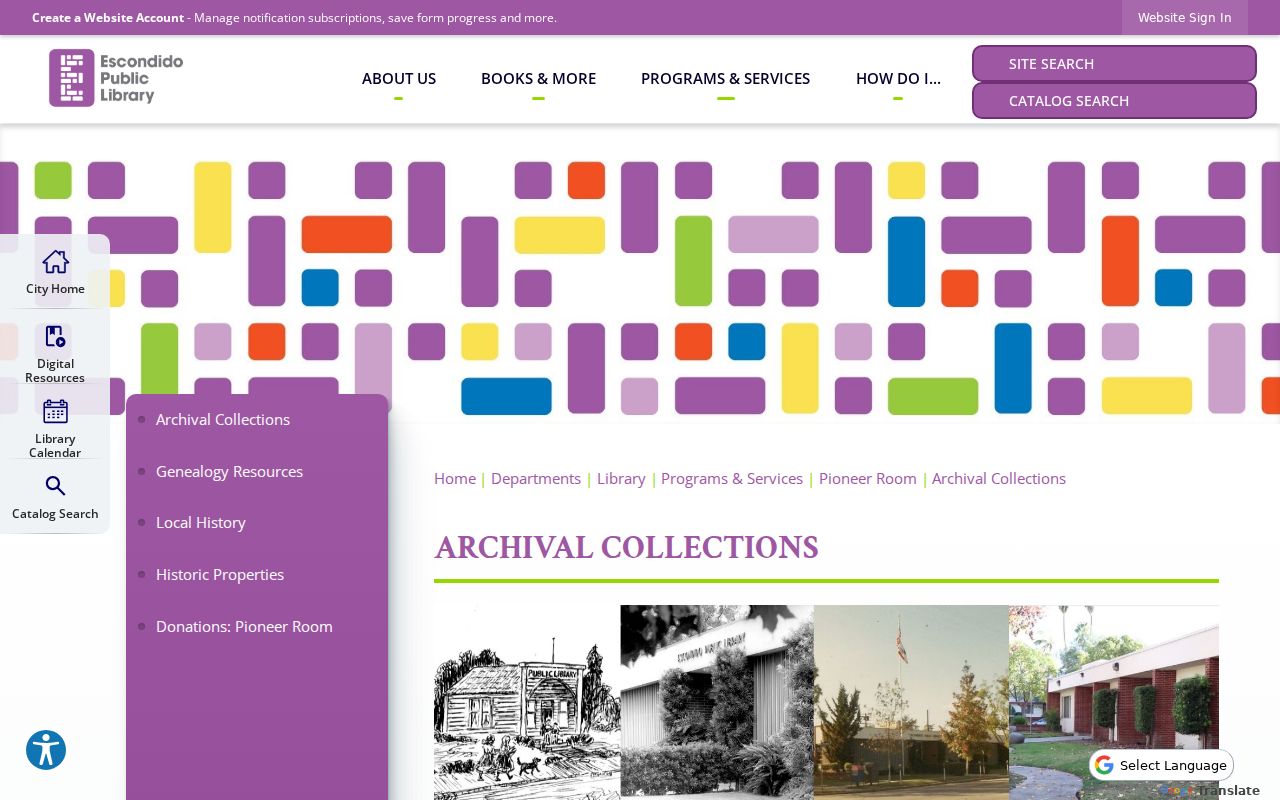
Archival collections add organizational papers, photographs, and personal materials to the year-by-year city directory trail.
Plan an Escondido Directory Visit
Bring a research note that names the target person or address, possible spelling variants, the exact year range, and the record question. Ask staff to check the directory shelf, clipping index, newspaper date, yearbook title, or historic-property file that fits the clue. Materials are non-circulating and fragile or oversized files may require staff handling.
Photograph the volume title, publisher, year, abbreviation key, page number, and the full entry. A short citation makes a later comparison possible. If the target is a current parcel rather than a historical listing, begin with the county assessment and city GIS paths on the Escondido street directory page. The city directory remains the place for the historical shelf, printed conventions, and year-by-year trail.