
Start an Escondido Residents Directory Search
There is no single current book of Escondido residents. A name search may lead to a recorded deed, a court party, a professional license, a business filing, or a historical directory entry. An address search starts with a parcel and then moves to documents tied to that parcel. The best source depends on the question. A deed identifies parties to an instrument. An assessment record describes land and value. A directory lists a subscriber or household clue for one edition. None, alone, proves that every person at an address lives there now.
The starter route below keeps those distinctions visible. Record the exact spelling, middle initial, former surname, trust or business name, date range, and street form you used. Escondido records also sit at three levels: the city, San Diego County, and California. A missing city result may simply belong with the county recorder or a state program.
- Start with the Escondido Parcel Lookup or secured assessment search when an address or street is known. Save the APN, situs, parcel status, and legal-description clues.
- Use California My Voter Status only for an authenticated self-lookup. A fuller voter-file request requires a permitted purpose and identity certification.
- Search the San Diego County Official Records Index by grantor and grantee name for deeds, trust deeds, releases, liens, and notices.
- For an older household, request the right year from the Pioneer Room’s city and telephone directory collection, then compare adjacent years and newspaper evidence.
- If a specific identifiable city record is not online, use the City of Escondido request route or the custodian’s counter and phone channel instead of asking an office to research an undefined person.
Where Escondido Resident Records Live
Escondido is incorporated, but it is not a separate county records jurisdiction. The city clerk handles municipal records and routes city requests. San Diego County ARCC combines assessor, recorder, and county-clerk work. The Superior Court holds case files, while state agencies control voter status, vital-record applications, licenses, custody tools, and Safe at Home protections. The office matters as much as the search term.
San Diego County ARCC
Recorder, Assessor, County Clerk
619-237-0502
Official records, assessment, and certificate services
Escondido City Clerk
201 N. Broadway, City Hall
Escondido, CA 92025
760-839-4617
San Diego Registrar of Voters
5600 Overland Ave.
San Diego, CA 92123
858-565-5800
ARCC’s public web index reaches from 1970 forward and displays index data, not the instrument image. Ownership is deliberately suppressed from the online secured-roll results. The city clerk’s public-record route is better for agendas, rosters, permits, and municipal correspondence. The county and state channels answer different questions, so a result should carry its custodian and date in your notes.
San Diego County ARCC’s service page is the source for the combined assessor, recorder, and clerk functions shown above.
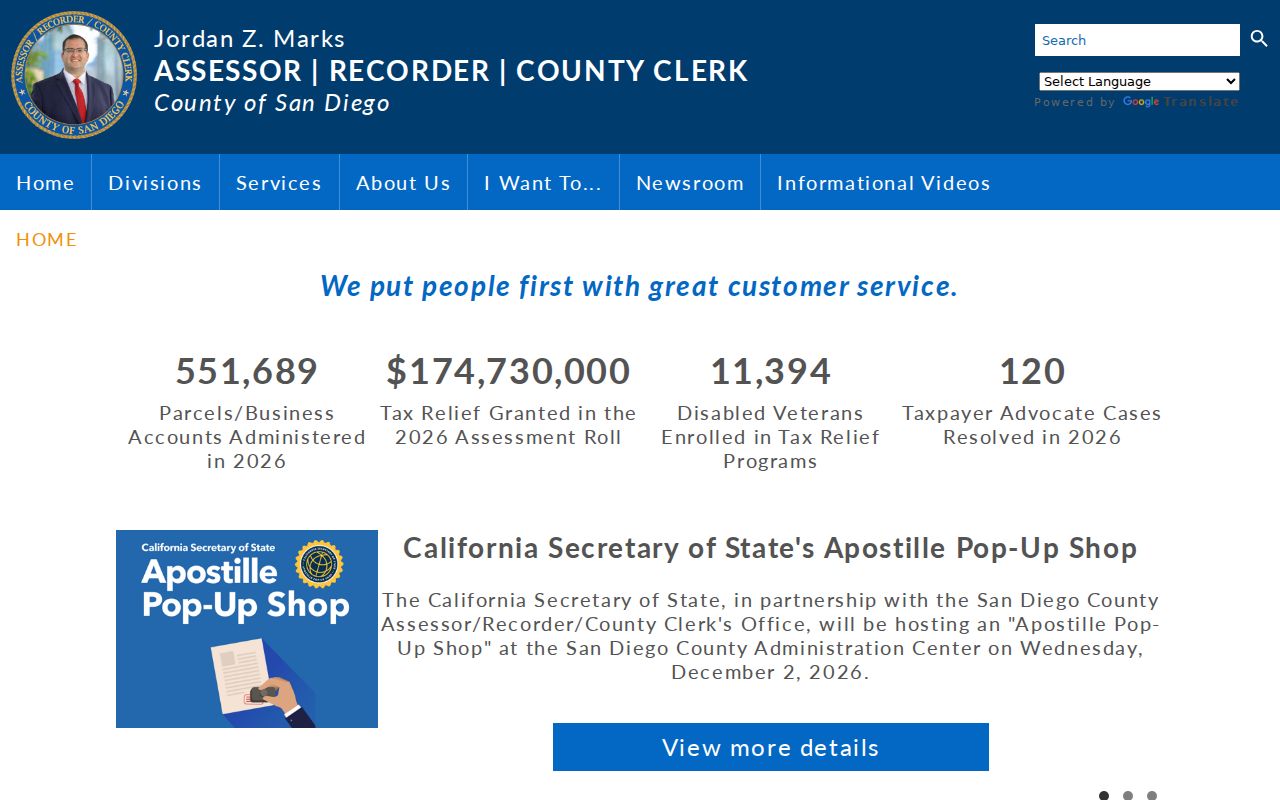
The county office is the shared custodian for the deed, assessment, and certificate paths, but each path still has its own access rule.
Escondido Assessor Records by Address
The 2026 Secured Assessment Roll Search accepts three useful routes: Parcel Number, Address, and Street Name. Street Name is intended for parcels without street numbers, which makes it useful for a broad street pass. A result may show the APN, situs, land value, improvement value, total assessed value, and exemption amount. The online result does not display the owner under California Government Code §7928.205, formerly §6254.21.
| Search field | How it helps | What to retain |
|---|---|---|
| Parcel Number | Targets one assessor parcel | APN, status, values, exemption |
| Address | Connects a situs to a parcel | Street form and returned APN |
| Street Name | Finds parcels without a street number | Street spelling and result set |
| Search / Reset | Runs or clears the form | Date of the search |
Use the secured assessment search for the free online parcel pass, then use the ARCC Property Information phone or kiosk channel when lawful ownership information is needed. A mailing address, if obtained through an allowed channel, can belong to a trust, manager, or nonoccupant owner. It is not proof of who lives at the situs.
Escondido’s public-record request portal supplies the city-level fallback when a municipal record is not searchable online.
City records add municipal context, while the county assessment result remains the source for the parcel facts.
Modern Escondido Residents Directory Sources
Modern directory work is best understood as a set of narrow sources. Each one has a keeper, a defined access mode, and a limit on what its entries mean. The table below separates ownership clues from residence, history, and official work-contact information.
| Source | What it lists | Keeper | Access |
|---|---|---|---|
| Secured assessment roll | Parcels, situs, assessed values | San Diego County Assessor | Free online; owner withheld |
| Official Records Index | Deed and lien parties | San Diego County Recorder | Free index; image by kiosk or copy |
| My Voter Status | Authenticated status and district | California Secretary of State | Personal lookup |
| City staff directory | Public work roles and contacts | City of Escondido | Official city website |
| Licenses and business filings | Professional or entity affiliation | California agencies | Free agency searches |
For one person, the Escondido resident lookup workflow compares two independent clues. For a street, parcel geometry and recorded instruments are the useful spine. For past residents, the Pioneer Room is stronger than a current roll because its directories and clippings preserve dated listings.
Escondido Voter Lookup Is Personal
My Voter Status is an authenticated self-service check. Its prompts may ask for a first name, last name, date of birth, California driver license or identification details, or other verification. The result can show registration status, party preference, registration address or mailing status, precinct, district, and election information for the authenticated voter. A failed match is not proof that someone is unregistered.
California Elections Code §§2180-2194 controls fuller voter-file access. Section 2194 limits use to election, governmental, scholarly, journalistic, or political purposes and bars commercial use. An application requires requester identity, contact details, requested geography or data, permissible purpose, security commitments, and a signed certification. Driver-license data, Social Security fragments, signatures, and Safe at Home addresses are not ordinary public directory fields. Voting history records participation, never a ballot choice.
That design makes the voter tool useful for personal verification but unsuitable for browsing a whole Escondido street. Historical poll books or registration registers require a separate archives or library inquiry, and no Escondido-specific historical poll-book run was verified.
California My Voter Status shows the personal authentication path and its limited purpose.
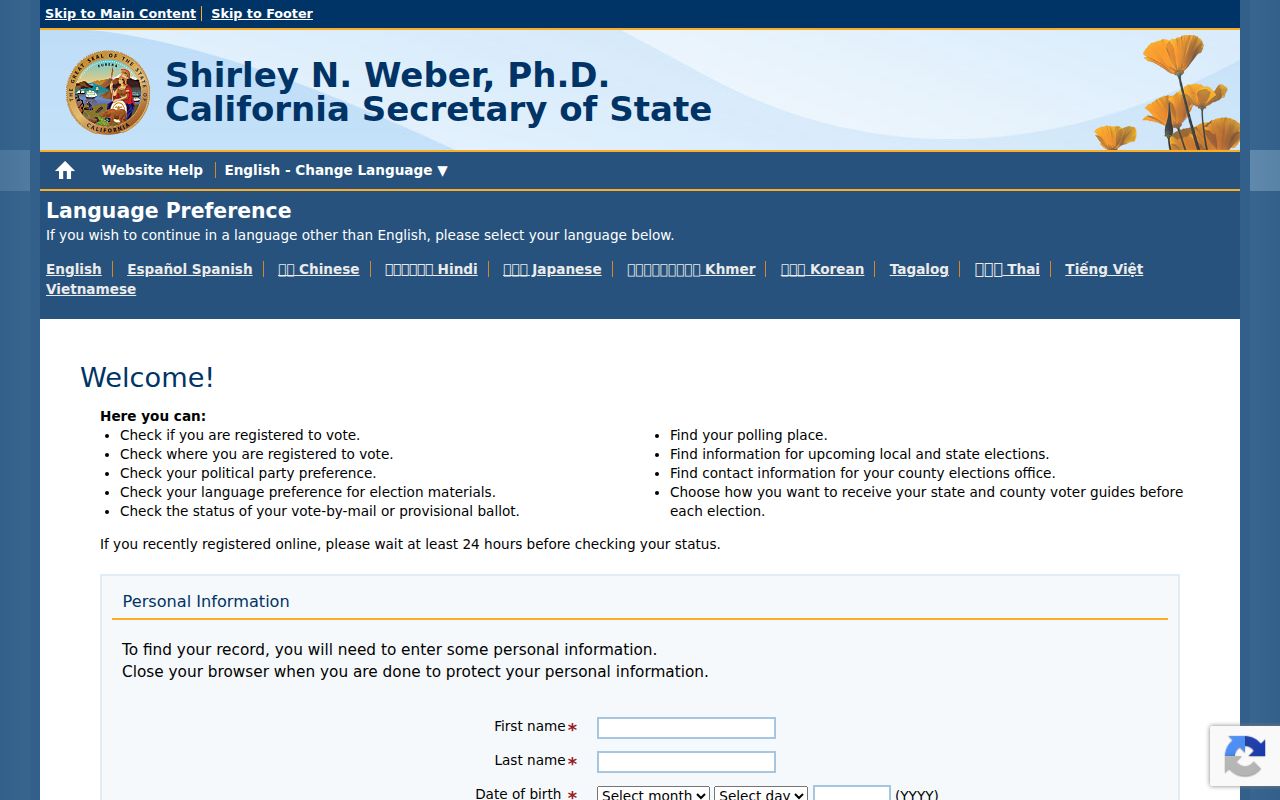
The authenticated form confirms the voter’s own registration information rather than exposing a public Escondido name directory.
Escondido's 1970 Recorder Divide
The Official Records Index reaches 1970 forward online. The free result gives party names, grantor or grantee role, document type, recording date, document number, and index references. It does not display the deed image. Copies can be ordered through ARCC, or an image can be viewed at a public kiosk. Mail requests identify the document number, recording year, a party, and document type. Published copy charges are $2 for the first page, $0.05 for each additional page, and $1 for certification, with a $2.50 card charge.
AB 1785 changed the address workflow on December 9, 2024. APN searching disappeared from the online index but remains at five ARCC office kiosks. For an Escondido parcel, the practical bridge is address to APN, then an allowed assessor channel or kiosk search. For records before 1970, the County Archives and ARCC books carry the chain through older grantor-grantee indexes and record series.
ARCC also offers a free Owner Alert service. One email can monitor up to ten names and ten APNs for documents recorded after enrollment. An alert gives a document number and link, not the instrument contents. It is a fraud-notification aid, not a resident directory.
Escondido Court Records Are Leads
Escondido-area matters are served through the San Diego Superior Court’s North County Division in Vista. The court’s access routes split civil, criminal, family, mental-health, and probate material. A case-number search is most precise. A party-name search should preserve spelling variants and then confirm the courthouse, case type, and a second non-sensitive fact.
The Superior Court access page explains the online, clerk, and courthouse-terminal routes. A public result may show case number, title, party names and roles, filing date, category, courthouse, status, register-of-actions events, hearings, and a public disposition. Sealed records, juvenile cases, adoption matters, confidential family material, and protected identifiers may be absent or redacted. A docket hit confirms named-party involvement, not a current address or identity by itself.
The county court access screen makes the separate case-type routes visible before a name search begins.
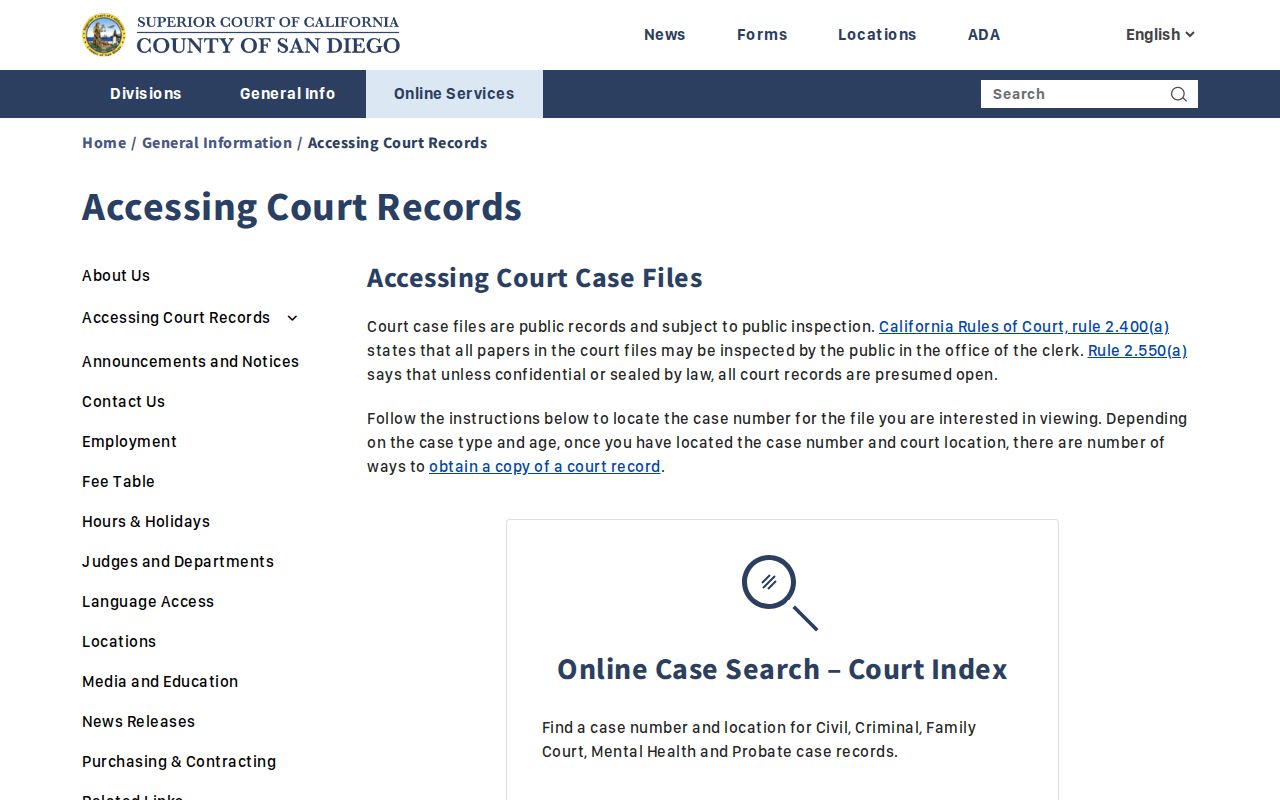
Court access is a lead-finding step. Identity still needs a second independent fact.
Escondido Vital Record Copies
California does not use a simple age cutoff for every birth, death, or marriage record. Health and Safety Code §103526 distinguishes an authorized certified copy, which can establish identity for listed eligible people, from an informational certified copy. The latter is marked as not valid to establish identity. Confidential-marriage copies follow a separate route under Family Code §§509-511 and are limited to a party or specified legal process.
San Diego County ARCC and the California Department of Public Health accept applications for local and statewide vital records. An application can ask for the event type, names, date and place, parents or spouses where relevant, copy type, eligibility category, signature, payment, and return method. A mail request for an authorized copy may require a notarized sworn statement. Divorce decrees come from Superior Court; CDPH’s certificate of record is a limited abstract for covered years, not the decree.
Use the current ARCC birth, death, and marriage instructions or CDPH Vital Records application before paying. Fees and processing times change. No universal live name index for all California vital events was verified.
Escondido's Historical Directory Shelf
The Pioneer Room holds Escondido city and telephone directories from 1886 through 2018, a run that begins before incorporation in 1888. Business-directory photocopies cover 1913-1938. Sanborn fire-insurance maps span 1892-1927, and the local-history holdings add newspapers, yearbooks, property clippings, city parcel maps, photographs, organizational papers, and research files. The old volumes can show a listed name, spouse, occupation, address, telephone, and sometimes a home or residence mark, but they do not identify every adult at an address.
Some 1950s-1980s volumes are available through California Revealed. The 1955 Fifth Edition, published by Glendale Directory Co., uses a triangle before the telephone number for the Escondido prefix. Entries show the person’s name, a spouse in parentheses in many cases, occupation or business, address, and `h` for home or `r` for residence. Keep the volume’s abbreviation key and printed symbols before normalizing a transcription. The complete collections and reading method belong on the Escondido city directory page.
Escondido Directory Shelf at Pioneer Room
The Pioneer Room is at 247 S. Kalmia Street and publishes limited hours of Thursday 4-8 and Friday-Saturday 10-2. Materials are non-circulating. Appointments are not required, but advance contact helps when a request involves clipping files, fragile material, or oversized plans. Staff accept local-history, genealogy, obituary, and house-history research requests.
Its genealogy page confirms in-room access to Ancestry, Fold3, and Newspapers.com, plus DigitalReel on library computers or library Wi-Fi and FamilySearch Affiliate access for some restricted images. DigitalReel is especially useful for local papers before 1995. A remote search should ask for a name or address, exact directory years, newspaper dates, and spelling variants, then treat any staff result as a lead to be checked against the underlying record.
These shelves carry the human layer that county indexes miss: organizational newsletters, oral histories, personal papers, photographs, and historic-property clippings. The Escondido History Center is a separate institution with its own research center and collections. It reports more than 7,000 photographs and thousands of documents and artifacts, so it can add context without being mistaken for an official residence list.
Escondido's Focused CPRA Route
California’s Public Records Act is codified at Government Code §§7920.000-7931.000. It provides a route for any person to request identifiable, nonexempt state or local records. The agency generally has ten calendar days to determine whether the request seeks disclosable records, with a possible written extension of up to fourteen days in unusual circumstances. That is a determination deadline, not a promise that production will be complete by day ten.
For city material, use Escondido NextRequest and describe an existing record, date range, department, street address or APN, permit or case number, and preferred electronic format. Search completed requests first. Fire-code and incident records can follow the portal, while EMS patient-care information uses a patient or authorized-party channel because HIPAA restrictions apply. The city need not create a new record or answer a broad research question.
For a county or state record, send the request to the agency that holds it. Ask for reasonably segregable nonexempt portions and the reason for any redaction. Inspection is ordinarily free, while copies or electronic extraction can carry lawful direct costs. A precise request protects time and leaves a clear trail for correction.
Protected Escondido Resident Addresses
California’s Safe at Home program supplies a substitute mailing address and confidential forwarding for qualifying survivors and specified reproductive-health workers or patients. The actual location stays protected. Government Code §7928.205 also restricts posting specified officials’ home addresses and supports ARCC’s online ownership suppression. DMV address data is limited by the federal Driver’s Privacy Protection Act. Utility and delivery customer records are not public directory fields.
Lawful personal use. Escondido public records are for family history, civic research, reconnecting, and other lawful purposes. Do not use a name, address, or record trail to stalk, harass, intimidate, or harm another person. Verify a questionable entry with the custodian rather than trying to defeat a confidentiality program.
California consumer privacy rights can help with qualifying business-held information, including requests to know, delete, correct, or opt out of sale or sharing. The CPPA’s DROP platform is scheduled to direct registered data brokers to process verified deletion requests beginning August 1, 2026, but it does not erase county, city, court, or state source records. A correction belongs with the actual custodian.
Escondido Directory Terms, Defined
Old and modern indexes use short terms that can cause a wrong match when they are read too quickly. These distinctions keep an Escondido residents directory search tied to what a record actually proves.
- Roll
- An official list or account set, such as the secured assessment roll. It is not automatically a list of everyone living at each address.
- Index
- A finding aid with names, dates, document types, or numbers. It may point to an image without displaying the image.
- Criss-cross directory
- A reverse directory arranged by street and house number, useful for a dated subscriber or listed-household clue.
- Parcel
- A mapped unit of land identified by an APN. A proposed or retired parcel may bridge a subdivision change.
With those terms in mind, the Escondido residents directory becomes a source-matching task: choose the record that fits the clue, keep its limits attached, and move to the custodian for a certified or corrected copy.